Friday, January 16, 2009

Sony Ericsson Reports Crushing Fourth Quarter

Sony Ericsson is not alone in its struggle to ride out the global economic recession, but it may have fewer resources than some of its competitors to keep going until conditions improve. Right now, high-end phones offer the best market opportunity, says Forrester analyst Charles Golvin, and Sony Ericsson is weak in that department.


Sony Ericsson is the latest casualty of the global economic slowdown.

The joint venture between Japanese consumer electronics giant Sony and Swedish mobile phone maker Ericsson announced dismal fourth-quarter financial results on Friday.

The company lost 187 million euros (US$248 million) on 2.9 billion euros ($3.9 billion) in sales in the fourth quarter, down from a 373 million euro ($496 million) profit on 3.8 billion euros ($5 billion) in sales during the same period in 2007.

Sony Ericsson shipped 24.2 million handsets in the fourth quarter, down 21 percent compared to the fourth quarter in 2007.

The company lost 73 million euros ($97 million) for the full year in 2008, down from a 1.1 billion euro ($1.5 billion) profit during the same period in 2007.

Bad Time for Mobile Phones

Now is not a good time to be in the mobile phonebusiness.

American cell phone giant Motorola (NYSE: MOT) , already plagued by years of production and design issues, announced on Wednesday that it will lay off an additional 4,000 employees. The struggling wireless telecommunications company has already laid off thousands of employees in the last 12 months.

Also, Finnish mobile handset maker Nokia (NYSE: NOK) said on Dec. 4, 2008, that the global wireless phone market will decline by 5 percent in 2009.

"It's tough for everybody right now," said Charles Golvin, a wireless telecom analyst with Forrester Research.

Sony Ericsson Struggling Overseas

Sony Ericsson's exposure in the U.S. market is limited, because it doesn't have the same level of penetration that other foreign mobile phone makers have here. The only carriers to offer Sony Ericsson phones are T-Mobile and AT&T (NYSE: T) , Golvin noted.

However, Sony Ericsson is much more exposed in Europe and other parts of the world.

"At this point, most of the business in the developed economies is about refreshment," Golvin told the E-Commerce Times. "There aren't many new customers coming in. The cell phone makers have to convince people to upgrade -- but people are reluctant to get a new phone, because they're watching every penny they have."

Struggling at the High End

The foremost opportunity in the mobile deviceindustry is at the high end, Golvin said.

Consumers in that niche have more money to spend on top-tier phones such as the Apple (Nasdaq: AAPL) iPhone, Research In Motion's (Nasdaq: RIMM) BlackBerry Bold and the Samsung BlackJack.

Unfortunately for Sony Ericsson, it doesn't have nearly as many products to offer buyers at the high end of the market, said Golvin. "The only product they have is the Xperia X1, which was late to market."

The Xperia is powered by the Windows Mobile operating system, a platform that hasn't been very successful, especially in the consumer market, he pointed out.

Turnaround Coming?

Given the mobile phone industry's struggles, it's logical to ask when a turnaround might materialize -- but that's not an easy question to answer.

"There are so many factors here in terms of the economy," Golvin said. "It's not just the actual numbers in terms of job losses and foreclosures -- it's one of emotion and attitude. Even as things start to pick up from an economist's point of view, there will be a significant lag between those concrete numbers and consumers' actual attitudes."


Linux Elitism: Fact or Fiction?

Newcomers to open source software might be intimidated by the insider nature of the communities, but they shouldn't mistake that for elitism, writes LinuxInsider columnist Jeremiah T. Gray. Stick with it, and the benefits will become clear, he advises.


For users reared on GUI-oriented commercial operating systems, switching to open source POSIX-type OSes can be an onerous task. Whereas Linux, and FOSS in general, are built around the ideas of inclusion and sharing, the communities built up around the open source operating systems often face accusations of exclusive techno-elitism. Although there are assuredly a few smug members within the various FOSS communities and although shell fluency is more complex than simple commercial OS GUI administration, the scurrilous accusations of perceived superiority among open source communities and their members amount to little more than sour grapes.

In the tech world, communities are defined by their staunchest advocates. For instance, Apple (Nasdaq: AAPL) is well-known for sexy and sleek designs. Apple fanboys will often list physical attributes as key features of the products they vociferously defend (and you can hardly blame them for being turned on by the look and feel; multi-national corporations need defending from consumers like the Yellow River needs more toxic chemicals).

Elitists Abound

Apple makes flashy gadgets, and it gets a certain amount of cachet from the more fashionable segments of the tech world. Similarly but completely different, Microsoft (Nasdaq: MSFT) finds its biggest fans by pandering to the obtuse. After Apple ran an ad campaign making fun of John Hodgman for "[being] a PC," Microsoft based its self-deprecating ad campaign on Apple's and recruited its defenders to make low-resolution videos of themselves declaring themselves PCs.

Both Apple and Microsoft have elitists in their ranks. Some of the elitists are loyal consumers and others are, or have been, top executives. Although these strident supporters will get into debates with each other or even with members of open source communities, they're never accused of being the reason their platform of choice isn't universal.

Different Rules

The rules are different for open source operating systems, however, in part for good reason. First of all, open source POSIX-oriented operating systems tend to bring out a different crowd. For an amusing look at what unites Linux users, for instance, compare the search terms and results here to the search terms and results here.

Rather than being guided by the fashionable elegance of iPhones or the status quo of Windows, many champions of Free and Open Source Software base their usage and support on philosophical reasoning. Considering the history of the GNU Project, it should be no surprise that one can find ideological purists in the ranks of FOSS users (some who would doubtlessly object to my use of the term "FOSS"). The purists who identify with free software and its guiding principles are no more of a threat to the open source movement than Apple fanboys are a threat to Apple's profits. The difference is purely aesthetic.

The Disconnect

So why do some newcomers walk away from Linux/BSD decrying open source operating systems and calling the community members highfalutin? Mostly because they failed to work through what Seth Godin identifies as "The Dip" and proceed to misconstrue community values and attitudes. To experience the best things Linux/BSD have to offer, users must reorient themselves and learn to think about computing a little differently. For a user accustomed to GUIs, the command line can seem daunting and trivial, but after becoming more familiar, the user will recognize that the command line interface is an elegant, if not zen-like experience. The same goes for building software from source. So what the wounded newcomers sometimes interpret as condescension is actually more along the lines of teaching someone to ride a bicycle. It's not difficult to do, but it can only be done if the rider pushes through the initial doubt and confusion in order to experience the benefits.

Most open source enthusiasts want more people to embrace Free and Open Source Software solutions, but just like how the style of products is important to Apple aficionados, familiarity with the terminal and an appreciation of the under-the-hood mechanics matter to the FOSS lovers. That said, FOSS has an added element absent from the corporate-backed technologies. Whereas fans of products made by rather large businesses need to appeal in aggregate (or focus groups) to get noticed in the product design process, FOSS is a free-for-all. Anyone is free to bring anything to the table. While a lot of folks may get corporate logo tattoos and/or pontificate about what such-and-such company did right or wrong, few of them will ever have any actual input. On the other hand, if Joe Sixpack wants to make his own Linux- or BSD-based operating system with his own logo and software, he's free to do that. FOSS is based on empowerment and the appreciation of empowerment, and with empowerment comes responsibility.

Perhaps this is what the naysayers find objectionable.


Downadup virus exposes millions of PCs to hijack

LONDON, England (CNN) -- A new sleeper virus that could allow hackers to steal financial and personal information has now spread to more than eight million computers in what industry analysts say is one of the most serious infections they have ever seen.

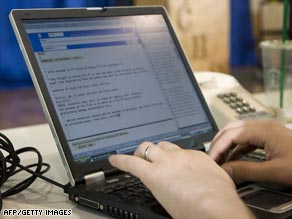
Experts say a single infected laptop could expose an entire network to the worm.

Experts say a single infected laptop could expose an entire network to the worm.

The Downadup or Conficker worm exploits a bug in Microsoft Windows to infect mainly corporate networks, where -- although it has yet to cause any harm -- it potentially exposes infected PCs to hijack.

Mikko Hypponen, chief research officer at anti-virus firm F-Secure, says while the purpose of the worm is unclear, its unique "phone home" design, linking back to its point of origin, means it can receive further orders to wreak havoc.

He said his company had reverse-engineered its program, which they suspected of originating in Ukraine, and is using the call-back mechanism to monitor an exponential infection rate, despite Microsoft's issuing of a patch to fix the bug.

"On Tuesday there were 2.5 million, on Wednesday 3.5 million and today [Friday], eight million," he told CNN. "It's getting worse, not better."

Hypponen explained to CNN the dangers that Downadup poses, who is most at risk and what can be done to stop its spread.

How serious is it?

It is the most serious large scale worm outbreak we have seen in recent years because of how widespread it is, but it is not very serious in terms of what it does. So far it doesn't try to steal personal information or credit card details.

Who is affected?

We have large infections in Europe, the United States and in Asia. It is a Windows worm and almost all the cases are corporate networks. There are very few reports of independent home computers affected.

What does it do?

It is a complicated worm most likely engineered by a group of people who have spent time making it very complicated to analyze and remove. The real reason why they have created it is hard to say right now, but we do know how it replicates.

How does it spread?

The worm does not spread over email or the Web. However if an infected laptop is connected to your corporate network, it will immediately scan the network looking for machines to infect. These will be machines that have not installed a patch from Microsoft known as MS08-067. The worm will also scan company networks trying to guess your password, trying hundreds and hundreds of common words. If it gets in, even if you are not at your machine, it will infect and begin spreading to other servers. A third method of spreading is via USB data sticks.

How can I prevent it infecting my machine?

The best way is to get the patch and install it company-wide. The second way is password security. Use long, difficult passwords -- particularly for administrators who cannot afford to be locked out of the machines they will have to fix.

What can I do if it has already infected?

Machines can be disinfected. The problem is for companies with thousands of infected machines, which can become re-infected from just one computer even as they are being cleared.

Music industry still faces huge online piracy

A piano factoryA piano factory. he global music industry is making progress in clamping down on online piracy by evolving radical new ways of selling tunes, but 95 percent of downloads remain illegal, a report said


The global music industry is making progress in clamping down on online piracy by evolving radical new ways of selling tunes, but 95 percent of downloads remain illegal, a report said Friday.

New business models helped the legal online music sector balloon for a sixth straight year in 2008, growing by 25 percent to 3.7 billion dollars (2.8 billion euros) in trade value, it said.

But some 40 billion music files were still illicitly shared last year, according to the International Federation of the Phonographic Industry (IFPI) in its annual report on the state of digital music.

"The music sector is still overshadowed by the huge amount of unlicensed music distributed online," it said, citing studies in 16 countries showing that only one in 20 downloads are via legal channels.

Cutting pirates' Internet connections is an increasingly-used option for dealing with persistent offenders, rather than threatening people with fines or other criminal sanctions.

But overall, things are looking up online: digital outlets -- as opposed to CDs and other traditional forms of music -- now account for some 20 percent of recorded music sales, up from 15 per cent in 2007, said the 30-page report.

Sales of single tracks continues to drive the digital music expansion, and were up 24 percent in 2008 to 1.4 billion sales, while online album sales also grew by 36 percent, according to the IFPI's Digital Music Report 2009.

New Orleans rapper Lil Wayne's "Lollipop" was the biggest-selling digital single worldwide last year, with 9.1 million copies sold -- a figure 1.8 million bigger than the best-selling single in 2007.

But new methods of selling are exploding, including a a new generation of music subscription services, social networking sites and new licensing channels, led by services like Nokia Comes With Music and MySpace Music.

Partnerships with Internet Service Providers (ISPs) are also opening up as a new sales route, including TDC in Denmark, Neuf Cegetel in France, Sweden's TeliaSonera and BSkyB in Britain.

"The recorded music industry is reinventing itself and its business models," said IFPI chairman John Kennedy.

"There is a momentous debate going on about the environment on which our business... depends. Governments are beginning to accept that... doing nothing is not an option if there is to be a future for commercial digital content."

The music industry body welcomed the way governments were collaborating with Internet providers to curb piracy.

"In 2008 a tipping point was reached, with governments in France and the UK leading the way in looking to ISPs to help bring piracy on their networks under control," it said.

In particular ISPs are cooperating in cutting Internet access for offenders.

"The momentum for ISP cooperation extends beyond France and the UK. New Zealand will start requiring ISPs to implement a policy of terminating the accounts of repeat infringers in February," it said.

Authorities in the United States, Italy, Australia, Japan, Hong Kong and South Korea are also thinking of such a move, according to IFPI.

There is also evidence that the digital expansion is having a negative effect on locally-produced music, reducing the number of home-grown artists, who struggle due to easy availability of music from around the world.

In France, album releases by new artists fell by 16 per cent in the first half of 2008, and home-grown music accounted for 10 per cent of albums, compared to 15 per cent in the first half of 2005.

In Spain, just one new local artist featured in the Top 50 albums from January to November 2008, compared to 10 in 2003.

Overall, though, the IFPI report was positive, saying it "shows an industry that has shifted its approach from one based only on unit sales of music to 'monetising' access to music across a multitude of channels and platforms